Sunday, August 31, 2008

Medical care for non-smokers only

Not surprisingly to those familiar with increasing fanaticism of the nanny state, also in Germany there are first attempts of denying smokers equal access to medical treatment.
Dr. Jochen Mathews, surgeon at the Heidekreis hospital in Soltau (Lower Saxony) called a patient one day before her long scheduled operation on her cruciate ligament to tell her that she has to take a tobacco withdrawal course first. If ‘successful’ she would be entitled to the operation.
Asked by a journalist, the physician replied that he never operates smokers, only in acute cases of emergency.

Others hospitals reacted bewilderedly, some had never heard of such an incident, smokers are generally treated the same way as non-smokers.
The Heidekreis hospital tried to defend itself against the outrage created by its employee. The director claimed that the patient's alleged bronchitis would require a three-week postponement of the operation. Interestingly, the woman was operated a few days later in another hospital.

Apparently, some medical doctors don’t take the Hippocratic Oath but the Hypocritical one.

Sunday, August 03, 2008

The court ruling - the positive aspects

Many owners und regulars of small German bars will remember the 30th of July, 2008, as the day when the ashtrays came back.
The decision of the German Constitutional Court brought some freedom of choice to many venues, de jure in Berlin and Baden-Württemberg, de facto also in most other states.

Although Germany is far from being in a post-ban situation, life has become easier for many. Whatever the states may decide in the coming months, social life and business figures can recover after the losses they faced.
And the discussion about smoking, smoking bans and the nanny state in general remains on the agenda.

The stakes are higher now, the antis push for total bans, but the number sceptical voices in the media and in politics increases as well.

As Joe Jackson pointed out in a recent column:

(a) The states now have until the end of 2009 to re-write their laws, and until then, smoking is allowed.
(b) The rights of bar owners and the fact that smoking bans hurt business, have been officially recognised.
(c) It demonstrates that action can make a difference.
(d) We have another year and a half to fight the antismoking fascists.

Forces Germany will of course take that challenge.

The court ruling - education by force

Although the decision of the German Constitutional Court offers a short-term relief for many bar owners and customers, its overall message is very dangerous.

It has been critized sharply not only by Netzwerk Rauchen - Forces Germany.
Dr. Josef Iseensee, Professor emeritus at the University of Bonn and a very renowned scholar of constitutional law, calls it "a pyrrhic victory for professional freedom because it paves the way for a total smoking ban and thereby for an ecological education by force of the complete population".
According to him, the court allows "brutal action" in the field of "health protection".

One of the eight judges, professor Masing, in his minority vote, fears a "patronizing paternalism" through total smoking bans.

Professor Winfried Hassemer, the former Vice President of the Constitutional Court, attacks the tendencies to "ostracize" tobacco as a drug - and the lobbies behind it. That makes him one of the few who openly point out that these bans are anti-smoking instead of 'protecting' anyone.
"The cigarette is a part of our culture", the retired judge, a non-smoker, says, "On the street, I sometimes walk behind someone who smokes a good cigarette, I smell that and enjoy that as well. There is no point in being radical about things that have to do with the general everyday life."

In addition to the mentioned jurists, professor Günter Ropohl, the author of "Smokers of all countries, unite!", also comments negatively about the ruling, describes it as being "contradictory and biased".

Wednesday, July 30, 2008

Smoking bans in Germany – unconstitutional!

A few hours ago, the Federal Constitutional Court in Karlsruhe declared the smoking ban laws of two German states unconstitutional. Single-room pubs with less than 75 sqm that serve no food and aren’t accessible for people under 18 are now provisionally allowed to permit smoking .This decision indirectly applies to at least 12 of the 14 other German states.
Provisionally - because the states have to make constitutionally correct laws by the end of 2009.

Three owners of small bars in Baden-Württemberg and Berlin had called for judicial review. The court ruled that their entrepreneurial freedom is overly restricted by the smoking bans in the hospitality sector as long as bigger venues with several rooms may designate smokers areas. Hence, the court’s main legal argument is leveling the playing field.

The court offers two options:
1) A total ban without any smokers areas and separated rooms in bars and restaurants.
2) Exemptions for small single-room venues in addition to the possibility of separating rooms.
Option 1) is no solution as it would worsen the situation.

Unfortunately, the court echoes the passive smoking fraud. And only one (possibly two) of the eight judges thinks that a total smoking ban in the hospitality sector would be unconstitutional.

More information to follow.

Sunday, July 27, 2008

Austria: Smoking ban regardless


On July 9, the Austrian Parliament has passed a tightened version of the national Tobacco Law, which - amongst other things - regulates smoking in the hospitality industry.
From January 2009 on, there will be a general smoking ban in bars and restaurants. This smoking ban is eased by a number of exceptions and leaves the innkeepers a certain freedom to choose.

Bars and restaurants over 80 square meters have to provide a separated non-smoking area that makes up at least fifty percent of the venue's total area.
If the bar or restaurant is not bigger than fifty sqm (or eighty sqm, if the local authorities agree that the available room cannot be partitioned into two separate rooms), it is totally up to the owner to decide, whether he or she wants to operate as a smoking or non-smoking business.
All smokers rooms have to be provided with warning signs ("Smoking endangers your own health and the health of your fellow people").

Although the original conception of the law comprised various
restrictions with regard to employee protection, most of those have been discarded. Nevertheless there are restrictions for mothers-to-be and juvenile trainees.

Austria: Surprising Health Minister

Like her counterparts, Austrian health minister Andrea Kdolsky is a self-confessed fighter against tobacco.
However, she comes to the conclusion that smoking bans in the hospitality industry are futile, because „People in Italy unfortunately do not smoke less than before the ban, they just resort to smoking in the streets. So far there is no indication that a smoking ban in bars and restaurants might lead to a change of general smoking behaviour.“

Such a degree of forthrightness is something we would not have expected from one of today's health ministers. She frankly admits that the ban's main purpose is the decimation of active smokers. At the same time she refutes her Italian colleague's thesis about the ban's „positive“ effects.
Contrary to the concept of public health authoritarianism, Kdolsky furthermore declares that she appreciates the „freedom of the indivdual“, conceding that „in his or her own domain everybody should be free to do what he or she likes“.

As if this saying would not be a revolutionary enough feat for a health minister, Kdolsky's view of the Secondhand Smoke legend is a pleasant exception in comparison to the usual propagandistic delusions spread by her colleagues.
She states that there are „lively debates about this topic“, but at the same time admits
that “in view of recent scientific findings she cannot confirm“ the assertion that Secondhand Smoke causes up to one hundred fatalities in the Alpine Republic per annum.
How true! By contrast, Germany unfortunately seems to be ruled by credoulousness and the ignorance of scientific facts.

Another intriguing point is, that the alleged number of fictitious victims of Secondhand Smoke
given for Austria is proportionally (in relation to the total population) much smaller than the one
estimated for Germany.
On the other hand, Austria's smokers make up a higher percentage of the population. According to official data from a study by order of the Ministry of Health, the majority (!) of adult Austrians indulges in smoking.

This is not a small, almost evanescent minority that may be easily used as a scapegoat.
Finally, Austrian citizens tend to be more critical concerning the big cleansing project for a „Smokefree Europe" than other people in the EC.

Wednesday, July 09, 2008

Smoking bans in Germany – Jurisdiction

Laws are theory, jurisdiction is practice. And there have been some interesting court decisions regarding the German smoking bans.

In March, the State Constitutional Courts in Rhineland-Palatinate and in Saxony ruled that bars with just one room (thus no possibility of separating a smoking area) are provisionally exempt because they could face bankruptcy while waiting for the court's final decision. But this applies only to venues without employees.

In April, an Administrative Court in Schleswig-Holstein came to the same conclusion in an individual case, the State Administrative High Court recently expanding this to a venue with two rooms and one employee. All similar bars in Schleswig-Holstein can refer to these specific cases and ignore the ban.

Shisha bars are provisionally exempt from the smoking ban in Saarland, according to a verdict of the State Constitutional Court in March.

The funniest verdict came from an Administrative Court in the above mentioned Schleswig-Holstein. It ruled that a bar owner does not have to abide by the legal requirement to put up no-smoking signs. The judges just said: A no-smoking sign is not an effective means to enforce a smoking ban.

There were also a couple of attempts for judicial review by bar owners and individual smokers that failed. And Bavarian smokers' clubs that stood the test of law.

Why do most of these decisions have an interim character? Because the most important and powerful of all German courts, the Federal Constitutional Court in Karlsruhe, will rule in a few weeks, probably on July 30. Everybody is waiting for its position on the no-smoking laws of two states.

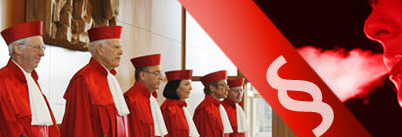
It is widely expected though unsure that “Karlsruhe”, the “Red Robes”, will declare parts of these laws to be unconstitutional. Yet it might be possible that they base this judgment on the uneven competition between one-room bars without the possibility of separate smoking areas on the one hand, and larger venues which have this possibility on the other. In this case, leveling the playing field could also mean abolishing smoker rooms altogether, at least as a legislative reaction.

Update: Also in Berlin, shisha bars (at least those that don't serve alcoholic beverages) are exempt until the final decision.